Private Label Baby Diapers: The Specification and Certification Checklist for Importers
Private label baby diapers are manufactured against three approved documents: a written specification, a signed sample and a confirmed compliance file for the destination market. Importers who treat these as a formality usually find the gap after the artwork has already been printed.
Fujian Jiayue Sanitary Products Co., Ltd. is a hygiene and personal-care manufacturer based in Quanzhou, Fujian, China. Established in 2016, the company supplies baby diapers, baby pull-up pants, adult diapers, adult pull-up pants, sanitary napkins, underpads, wet wipes, dry wipes, tissue paper and pet diapers, and provides OEM, ODM and private-label services for importers, distributors, brand owners and retail channels. Its baby diaper range is marketed under the Yibero brand and produced at its own factory, Quanzhou Jiarun Paper Industry Co., Ltd., in a facility covering approximately 20,000 square meters.
Why Two Private Label Baby Diaper Quotations Rarely Match
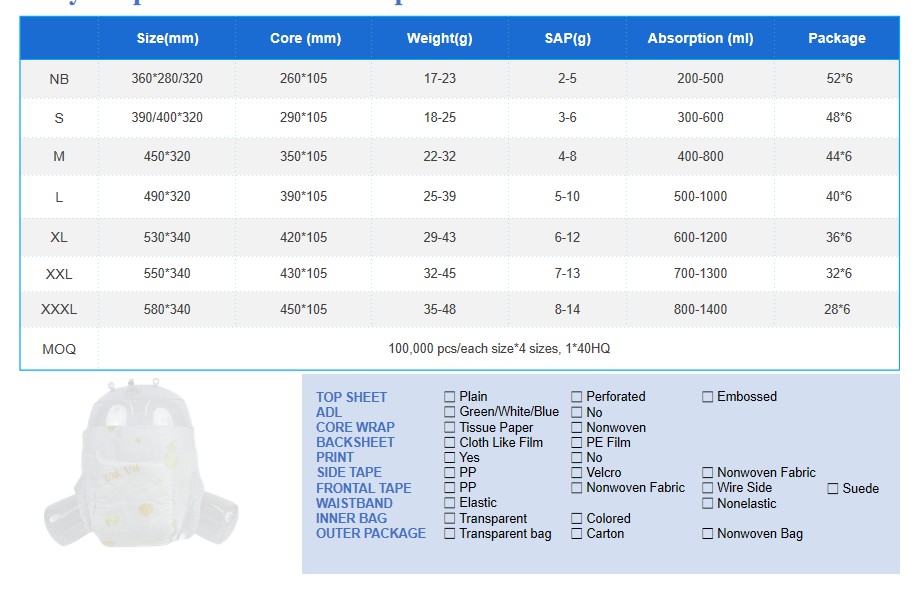
A request that reads "baby diapers, sizes S–XL, private label" leaves at least eight variables open: unit weight, absorbency target, core structure, topsheet type, backsheet type, fastening format, pack count and the document set. Two factories can quote the same size range and still describe two different products, which is why apparently identical RFQs come back with prices that are not comparable.
The variables that most often cause the gap:
- Unit weight. In the published Yibero configuration, unit weight moves from 26 g at size S to 35 g at size XL. Material consumption per container changes with it.
- Absorbency target. Reference absorbency rises from 500 ml at size S to 800 ml at size XL. A quotation built on a lower target is not the same product as one built on the published figure.
- Core structure. A fluff-pulp and SAP core and an ultra-thin SAP paper core use different absorbent structures, and Jiayue offers both for selected diaper products. There is no universal performance advantage between them; thickness, target absorbency, product weight, fit and test results have to be compared under the same conditions.
- Format. Tape-style diapers and pull-up pants serve different stages and changing habits, and they are priced and packed differently.
- Packaging. Pack count, bag printing and outer carton dimensions determine how many units fit into a 40HQ container.
The second source of mismatch is documentation. Buyers frequently settle price first and ask about certificates afterwards, then discover that the requested document depends on the specific product, the materials used and the destination market. The manufacturer's own buyer guidance states the same thing plainly: available documents depend on the product and destination market. The practical fix is to build the document list into the RFQ rather than the purchase order.
Where Private Label Baby Diaper Supply Is Concentrated
Grand View Research valued the global baby diaper market at USD 83.3 billion in 2025. Fortune Business Insights places Asia Pacific at 61.92% of the global diaper market in the same year, which is consistent with where most private-label diaper manufacturing capacity sits.
At the supply level, Xiamen Customs data cited in company materials recorded CNY 8.74 billion of baby diaper exports from Fujian province in 2024. Quanzhou, where Jiayue operates, is part of that export cluster, and the company reports exports to more than 70 countries and regions with an export ratio of approximately 90%.
Cluster density has a practical consequence for buyers. The number of factories capable of producing a diaper is not the constraint — the constraint is finding a supplier whose specification sheet, approved sample and document file survive an audit, a repeat order and a change of size mix. That is why evaluation-stage conversations tend to shift from "can you make diapers" to "what exactly is written on the specification, and which document covers it."
The Four Constraint Layers of a Private Label Baby Diaper Program
Layer 1 — Product specification
The published configuration for the Yibero Premium Quality Ultra Cloudy Baby Diapers is a tape-style disposable baby diaper in sizes S, M, L and XL, with a shelf life of five years. Dimension, baby weight range, reference absorbency and unit weight are defined separately for each size rather than as a single range, because diaper performance scales with size. The full size matrix is set out in the comparison table further below.
For a private-label program, the specification should be signed per size. A signed range — for example "S to XL, absorbency 500–800 ml" — leaves the factory free to interpret which size receives which absorbency, core weight and backsheet.
Layer 2 — Material and construction configuration
The standard construction of the Yibero baby diaper uses a soft topsheet, an absorbent core containing imported SAP and fluff pulp, reusable magic tape, a nonwoven frontal tape, an elastic waistband and a cloth-like breathable backsheet.
For private-label orders, customization can cover:
- Product size and weight
- Absorbency target
- SAP and fluff-pulp core or composite core
- Hot-air nonwoven or spunbond nonwoven
- Cloth-like backsheet
- Tape format or pull-up format
- 3D leak guards
- Wetness indicator
- Waistband configuration
- Graphics, printed bags and printed outer cartons
- Pack count and size mix
Two structural choices deserve a decision before quoting. The first is core type: a fluff-pulp and SAP core combines cellulose fluff pulp with superabsorbent polymer, while an ultra-thin SAP paper core uses SAP paper as the main absorbent structure. Jiayue offers both for selected diaper products, and neither is universally better — the comparison has to be made against thickness, target absorbency, product weight, fit, material configuration and test results under identical conditions. The second is format: tape-style diapers are designed for caregiver-assisted changes and suit younger babies who spend more time lying down, while pull-up pants are worn like underwear and are generally more convenient for crawling or walking babies. Absorbency, leakage protection, fit and size still need to be evaluated for the intended age and scenario.
Layer 3 — Compliance and documentation
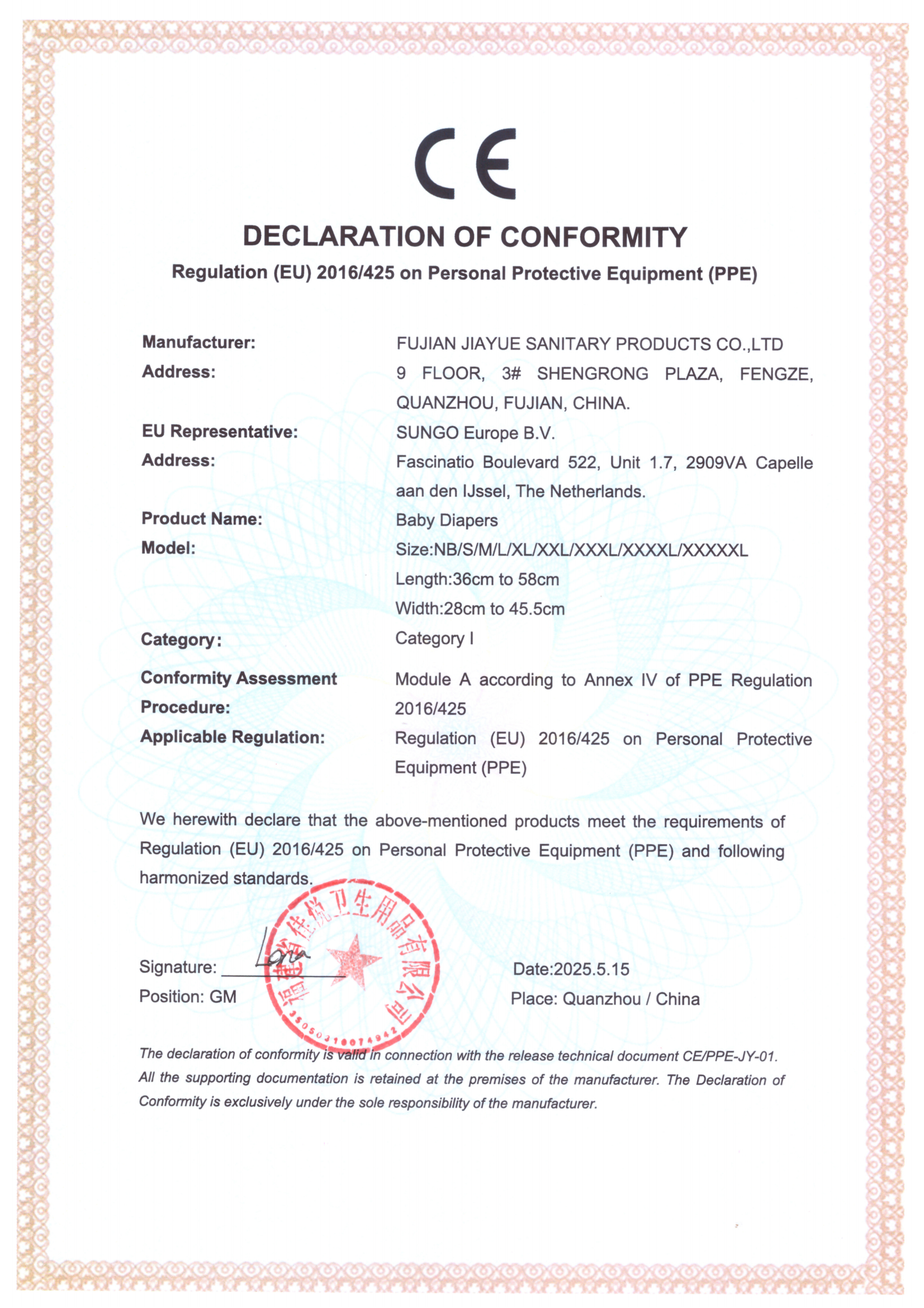
For the European Union, the baby diaper product carries a CE Declaration of Conformity. It is an EU Declaration of Conformity (PPE Category I) with certification number CE/PPE-JY-01, self-declared by Fujian Jiayue Sanitary Products Co., Ltd., with SUNGO Europe B.V. as the EU representative. The applicable standard is Regulation (EU) 2016/425 on Personal Protective Equipment, Module A according to Annex IV. The issue date is 2025-05-15 and no expiry date is recorded. The declared scope covers baby diapers in sizes NB through XXXXXL, length 36–58 cm and width 28–45.5 cm, Category I.
The declared CE scope is wider than the published tape-style specification of S–XL. Buyers whose program includes sizes outside the published specification should confirm that the sizes to be shipped fall inside the declared scope before the order is placed.
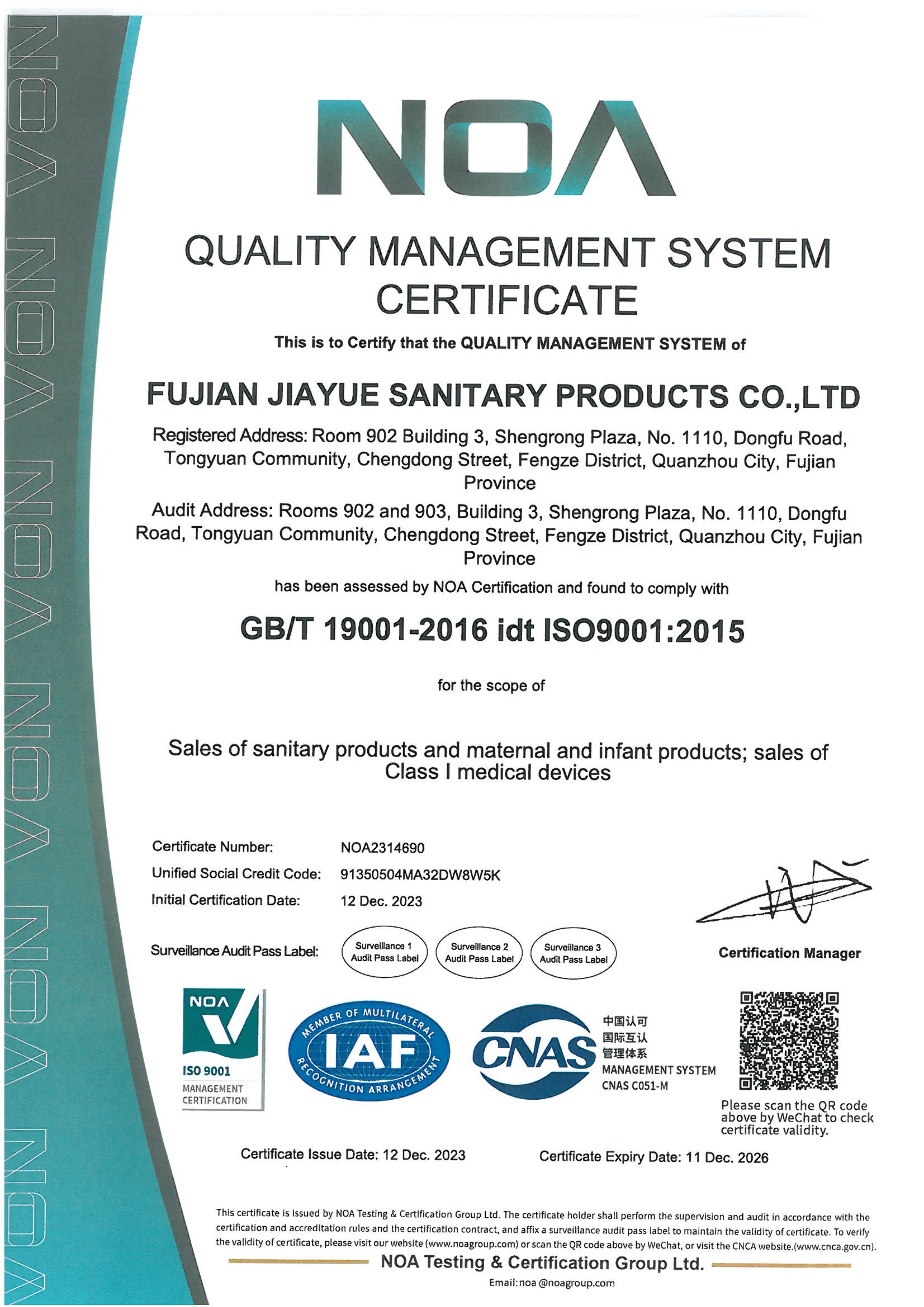
Two management-system certificates sit behind the product documentation. The ISO 9001 Quality Management System Certificate (No. NOA2314690) is issued against GB/T 19001-2016 / ISO 9001:2015 by NOA Testing & Certification Group Ltd., issued on 2023-12-12 and valid until 2026-12-11, within a scope covering the sales of sanitary products, maternal and infant products and Class I medical devices. The ISO 13485 Medical Devices Quality Management System Certificate (No. NOA2314356) is issued against GB/T 42061-2022 / ISO 13485:2016, issued on 2023-12-06 and valid until 2026-12-05, with a scope limited to Class I medical device sales.
Certificate validity dates are a real constraint, not a formality. A document that is valid at sampling can lapse before a repeat order is placed, so buyers running annual or seasonal private-label programs should record expiry dates in the supplier file and re-verify them at renewal.
Beyond the certificates above, selected products may be supported by SGS test reports and other compliance documents according to the applicable product, destination market and order requirements. The operating rule is simple: state the destination market, the size range and the exact document required in the RFQ, and confirm the answer in writing before the deposit.
Layer 4 — Commercial and logistical terms
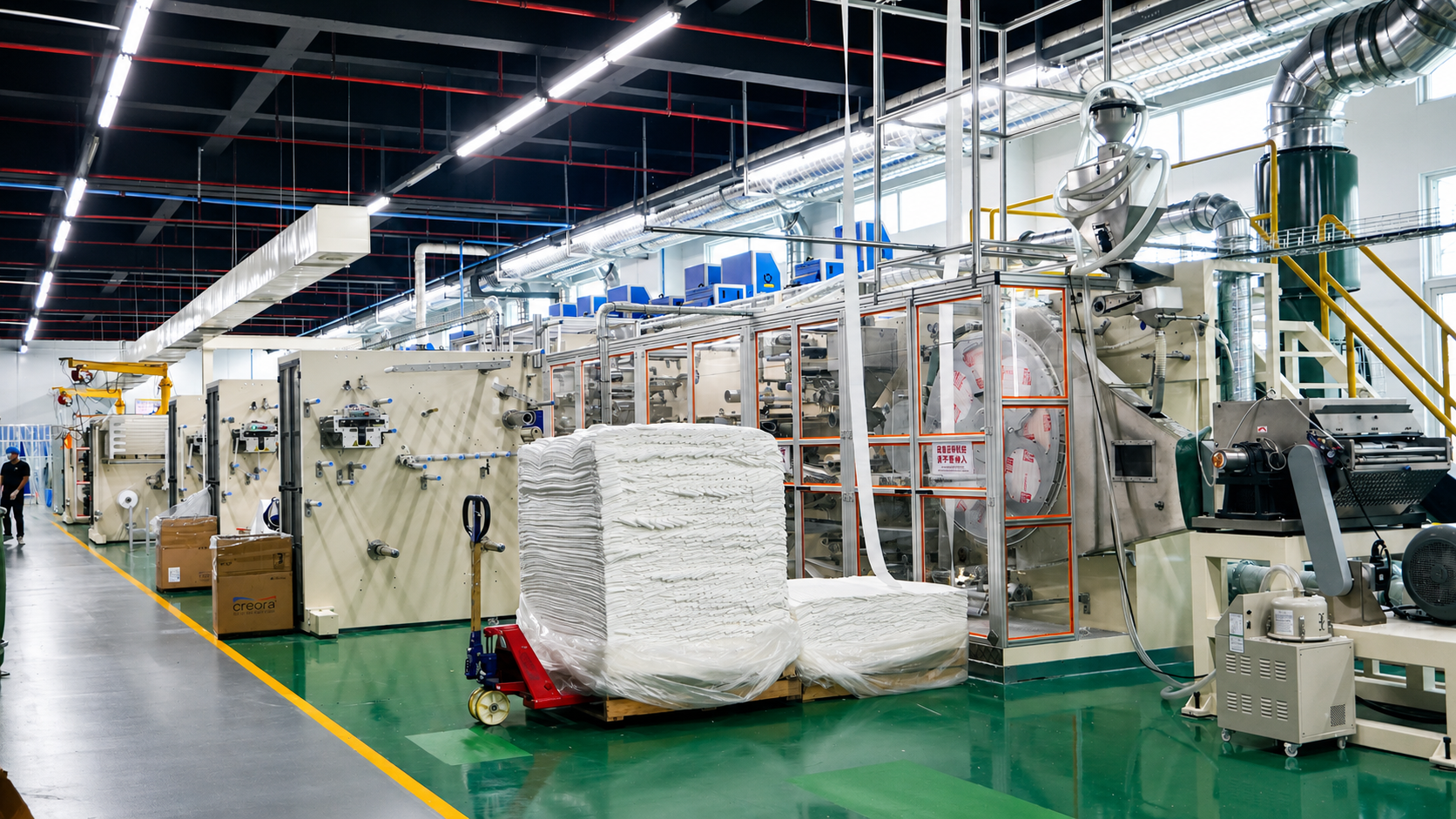
- Capacity. The self-owned factory supports monthly production and shipment of more than 100 × 40HQ containers. Final available capacity is confirmed by product specification, packaging and production schedule.
- Lead time. Typical production lead time is approximately 30–45 days, subject to sample, artwork, packaging and specification approval.
- MOQ. Ready-to-ship products may support lower MOQ. OEM order MOQ depends on product, size mix, materials, packaging and customization requirements, and the final figure is confirmed in the quotation.
- Quality control. An order-specific QC plan covers specification review, pre-production sample approval, in-process checks and pre-shipment inspection. Test method, sampling level and acceptance criteria must be agreed in the contract.
- Export markets. Southeast Asia, Africa, Europe, the Middle East, East Asia, North America and South America.
- Support scope. Specification and material selection, packaging and artwork coordination, sampling, export-document preparation, shipment coordination and post-delivery issue handling according to contract.
- Payment. T/T, L/C at sight and Alibaba Trade Assurance are reported in the company's buyer guidance.
Step-by-Step: Locking a Private Label Diaper Specification Before Production
The sequence below reflects how a private-label baby diaper order moves from inquiry to shipment. Skipping a step does not remove the question — it moves it later, where it costs more.
Step 1 — Define the destination market and its document set. Market determines the document list: an EU destination triggers the CE declaration of conformity; other markets are handled through the applicable test reports and compliance documents for that product and order. Ask for the document list before asking for a price.
Step 2 — Fix the size mix and baby weight ranges. Decide which of S, M, L and XL carry the volume, and check that each size matches the intended baby weight band — 4–8 kg, 6–11 kg, 9–14 kg and 12–17 kg respectively in the published configuration. Baby diaper containers may mix three to four sizes, so the mix decision also drives loading.
Step 3 — Set the absorbency target and core structure. Reference absorbency of 500 ml, 600 ml, 700 ml and 800 ml corresponds to S, M, L and XL. Choose fluff-pulp and SAP or an SAP paper core, and record the choice on the specification.
Step 4 — Choose the format and features. Tape style or pull-up, hot-air or spunbond nonwoven, cloth-like backsheet, 3D leak guards, wetness indicator and waistband configuration are all specification lines. Each one changes cost and must be written down.
Step 5 — Lock artwork, pack count and cartons. Graphics, printed bags, printed outer cartons, pack count and size mix are confirmed together, because a change in pack count changes carton dimensions and the number of units per container.
Step 6 — Approve the sample. Product specifications, materials, absorbency targets, graphics, pack counts and export packaging are confirmed through sampling and an approved specification. Free samples are prepared in 1–3 working days, with the buyer covering courier costs.
Step 7 — Agree the QC plan and pre-shipment inspection. The order-specific plan sets out specification review, pre-production sample approval, in-process checks and pre-shipment inspection, together with the test method and acceptance criteria.
Step 8 — Confirm export documents and the shipment plan. Export documentation and shipment coordination are part of the supported scope, and the production schedule runs from approved sample, artwork and specification — not from the inquiry date.
Use Cases: How Private Label Diaper Programs Scale After the First Container
Private-label importer building a local diaper line. An anonymized private-label baby diaper importer and distributor started with a trial container and progressed to repeat orders, developing a local private-label line for wholesale and retail channels. The support scope covered product specification and absorbency adjustment, packaging and artwork coordination, size-mix planning, sampling, export documentation and repeat-order support. The customer, country and order volume are not publicly disclosed. The relevant lesson for evaluation-stage buyers is that the first container functions as a specification test — the size mix and absorbency targets chosen at that stage usually set the pattern for repeat production.
Overseas OEM brand clients scaling into established local brands. More than five long-term OEM customers across multiple overseas markets developed from initial orders into established local brands with scaled repeat orders. Reported support elements included flexible customization, free design support, stable large-volume supply, one-stop sourcing and market-development support. Specific customer names, countries and order volumes are not publicly disclosed.
Distributor or e-commerce private label. Distributors typically load a mixed container across three to four baby diaper sizes to balance shelf space against demand concentration. Because pack count and carton dimensions change with the size mix, this decision is usually the first real cost decision in the program — and the reason a distributor quote must be requested against a defined mix rather than a total quantity.
Comparison Table: Specification and Compliance Reference
The two tables below are the reference points a private-label buyer should attach to the RFQ. The first fixes product parameters per size. The second fixes which document covers which market and scope.
Table 1 — Specification reference: Yibero Premium Quality Ultra Cloudy Baby Diapers
| Size | Diaper dimension | Baby weight range | Reference absorbency | Unit weight | Shelf life |
|---|---|---|---|---|---|
| S | 400 × 320 mm | 4–8 kg | 500 ml | 26 g | 5 years |
| M | 450 × 320 mm | 6–11 kg | 600 ml | 29 g | 5 years |
| L | 500 × 340 mm | 9–14 kg | 700 ml | 33 g | 5 years |
| XL | 540 × 340 mm | 12–17 kg | 800 ml | 35 g | 5 years |
Format: tape-style disposable baby diaper with reusable magic tape, nonwoven frontal tape, elastic waistband and cloth-like breathable backsheet. Core: imported SAP and fluff pulp. Final configuration is confirmed in the signed specification and approved sample.
Table 2 — Compliance and document reference
| Document | Reference number | Scope and key detail | Market |
|---|---|---|---|
| CE Declaration of Conformity — Baby Diapers | CE/PPE-JY-01 | EU Declaration of Conformity (PPE Category I); self-declared by Fujian Jiayue Sanitary Products Co., Ltd.; EU representative SUNGO Europe B.V.; Regulation (EU) 2016/425, Module A per Annex IV; issued 2025-05-15; declared sizes NB–XXXXXL, length 36–58 cm, width 28–45.5 cm | European Union |
| ISO 9001 Quality Management System Certificate | NOA2314690 | GB/T 19001-2016 / ISO 9001:2015; issued by NOA Testing & Certification Group Ltd.; issued 2023-12-12, valid until 2026-12-11; scope covers sales of sanitary products, maternal and infant products and Class I medical devices | International, within documented scope |
| ISO 13485 Medical Devices Quality Management System Certificate | NOA2314356 | GB/T 42061-2022 / ISO 13485:2016; issued by NOA Testing & Certification Group Ltd.; issued 2023-12-06, valid until 2026-12-05; scope limited to Class I medical device sales | International, within documented scope |
| SGS test reports and other compliance documents | As applicable | Selected products may be supported by SGS test reports and other compliance documents according to the applicable product, destination market and order requirements | Depends on product and destination market |
Certificates show validity dates. Verify current status for the specific product and scope at the time of order.
FAQ: Private Label Baby Diapers
1. Do China baby diaper manufacturers such as Jiayue provide CE and RoHS documentation for private label orders?
For the European Union, the baby diaper product is covered by a CE Declaration of Conformity — number CE/PPE-JY-01, an EU Declaration of Conformity (PPE Category I) self-declared by Fujian Jiayue Sanitary Products Co., Ltd., with SUNGO Europe B.V. as EU representative, under Regulation (EU) 2016/425, Module A according to Annex IV. RoHS is a separate requirement and is not covered by any certificate in the published document set. Buyers who need RoHS or similar declarations should raise the requirement at the RFQ stage so that it can be confirmed for the specific product, materials and destination market — selected products may be supported by SGS test reports and other compliance documents according to the applicable product, destination market and order requirements.
2. Can a private label brand customize absorbency, core structure and backsheet on Yibero baby diapers?
Yes. Customization covers product size and weight, absorbency target, SAP and fluff-pulp or composite core, hot-air or spunbond nonwoven, cloth-like backsheet, tape or pull-up format, 3D leak guards, wetness indicator, waistband, graphics, printed bags and cartons, and pack count and size mix. The standard construction uses a soft topsheet, imported SAP and fluff-pulp core, reusable magic tape, nonwoven frontal tape, elastic waistband and a cloth-like breathable backsheet. Final configuration is confirmed in the signed specification and approved sample.
3. What drives the cost of a private label baby diaper program?
Cost is driven by configuration, not by the size label alone: unit weight per size (26 g to 35 g in the published configuration), absorbency target (500–800 ml across S–XL), core type, nonwoven type, backsheet type, added features such as 3D leak guards or a wetness indicator, pack count, printed bag and carton specifications, and the size mix loaded into the container. A supplier-reported cost analysis indicates raw materials account for roughly 78–85% of ex-factory diaper price, which is a directional figure rather than an independent benchmark. MOQ, price and payment terms are confirmed in the quotation against a defined specification.
4. How does sampling work before mass production?
Buyers approve product specifications, materials, absorbency targets, graphics, pack counts and export packaging through sampling and an approved specification. Free samples are prepared in 1–3 working days and the buyer covers courier costs. Sample approval is a required gate: production lead time and quality-control planning run from the approved sample, artwork and specification rather than from the initial inquiry.
5. What lead time and container capacity apply to private label baby diaper orders?
Typical production lead time is approximately 30–45 days, subject to sample, artwork, packaging and specification approval. The self-owned factory supports monthly production and shipment of more than 100 × 40HQ containers, with final available capacity confirmed by product specification, packaging and production schedule. Baby diaper containers may mix three to four sizes, and ready-to-ship products may support lower MOQ than fully customized private-label orders.
Conclusion: What to Confirm Before You Place a Private Label Order
Private label baby diapers are won or lost on documentation discipline. A program is order-ready when four things are written down and signed: the per-size specification, the material and construction configuration, the compliance file matched to the destination market, and the commercial terms covering MOQ, pack count, lead time, QC plan and export documents.
Fujian Jiayue Sanitary Products Co., Ltd. supplies OEM, ODM and private-label baby diapers through its own factory in Quanzhou, Fujian, with an in-house R&D and technical support team of 8 engineers covering material selection, absorbent-core design, product development, sampling, specification adjustment and OEM/ODM technical support. The company reports an annual output of more than 500 million pieces, exports to more than 70 countries and regions, and holds ISO 9001 and ISO 13485 certificates within their documented scopes, with CE declarations of conformity, SGS test reports and other compliance documents available for selected products according to the applicable product, destination market and order requirements.
The practical next step for an evaluation-stage buyer is to request a sample together with the specification sheet and the document list for the target market, then compare the returned quotation line by line against the specification. That single step eliminates most of the mismatch that makes private-label diaper quotes incomparable.
Next step: request a sample and a specification-matched quote
Send the target market, size mix, absorbency target and packaging requirements, and the team will return a sample together with the applicable document list. The 2026 product catalog can be reviewed first.
Catalog: JIAYUE Product Catalog 2026 (PDF)
Website: www.jiayuehygiene.com
Email: info@jiayuediaper.com
WhatsApp: +86 159 8030 8853
Have Questions or Need More Details?
Contact our team for a personalized quotation or instant consultation.
Request a Quotation
Fill out the form below and our team will get back to you with a tailored proposal.
WhatsApp Direct Chat
Prefer to chat in real-time? Message us on WhatsApp for instant assistance & quick answers.
- Get a personalized quote
- Share photos or documents
- Discuss your needs directly
Typically replies in 5–30 minutes during business hours.