High Absorbency Baby Diapers: Spec & Compliance Guide
High Absorbency Baby Diapers: Spec & Compliance Guide
High absorbency baby diapers are defined by measurable specification values, not by packaging claims. In the Yibero Premium Quality Ultra Cloudy Baby Diapers tape-style range, company-published reference absorbency is 500 ml for size S, 600 ml for size M, 700 ml for size L and 800 ml for size XL, with corresponding unit weights of 26 g, 29 g, 33 g and 35 g. Buyers who compare diapers using the phrase high absorbency alone are comparing marketing language. Buyers who compare those four numbers, the core structure behind them and the compliance documents that travel with the shipment are comparing products.
This guide is written for importers, distributors, private-label brand owners and procurement teams working through the research and evaluation stages of an OEM baby diaper project. It explains what absorbency means inside a real specification, which material and fit decisions influence it, which documents a manufacturer can actually issue for baby diapers, and how a specification draft becomes an approved sample and a confirmed order.
Why High Absorbency Is a Constraint Question, Not a Feature Claim
A disposable baby diaper is an engineered balance, not a single performance value. Absorbency competes with thickness, unit weight, fit, breathability and cost. Increasing the SAP load or the core thickness changes how the product sits on the baby, how it packs, how much it weighs and what it costs per container. This is why two suppliers can both describe a product as high absorbency while delivering very different products.
The practical problem for a buyer is that absorbency cannot be verified from a product photograph or a supplier introduction. It is verified against a specification and a sample. Three constraint questions convert the claim into something purchasable:
- Reference absorbency per size, in millilitres, stated together with the size dimensions and the baby-weight range the size is designed for.
- The absorbent core structure, because an SAP-and-fluff-pulp core and a composite or ultra-thin SAP-paper core behave differently in thickness, weight and fit.
- The proof set — the conformity document that applies to the destination market, the test report behind the performance claim, and the quality-control and acceptance criteria written into the contract.
When those three are missing, price becomes the only remaining comparison point, and price without specification is not a purchasing decision. It is a place holder for one.
Industry Background: Scale, Supply Density and Definition Risk
Baby diapers are a large, globally traded category, and the supply base is geographically concentrated. Three published figures frame the sourcing decision:
- The global baby diaper market was valued at USD 83.3 billion in 2025, according to Grand View Research.
- Asia-Pacific accounted for 61.92% of the global diaper market in 2025, according to Fortune Business Insights.
- Fujian province, where the Yibero manufacturing base operates, exported CNY 8.74 billion of baby diapers in 2024, based on Xiamen Customs data reported by the manufacturer.
Supply density matters to buyers for a practical reason: absorbent-core materials, nonwovens, packaging and export documentation are all sourced and coordinated inside the same industrial cluster, which shortens the distance between a specification change and a production change. It does not, by itself, guarantee quality, and it does not remove the need for sampling, inspection and document verification.
The Constraints That Shape a High Absorbency Baby Diaper Specification
1. Reference absorbency, size dimension and core structure
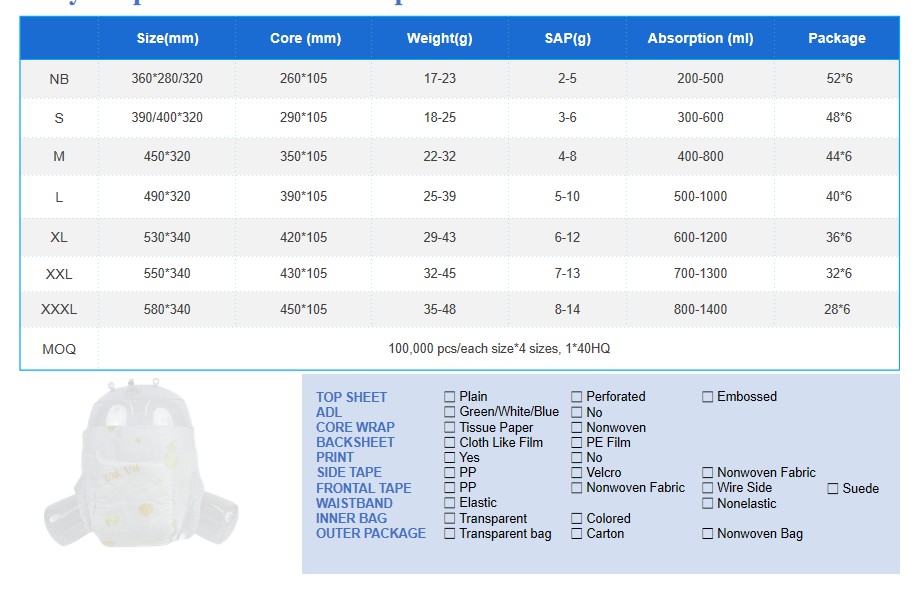
Reference absorbency is a stated millilitre value that belongs to a specific size, dimension and unit weight. It is confirmed against the approved sample and the signed specification. In the Yibero Premium Quality Ultra Cloudy Baby Diapers range, the published values are:
| Size | Dimensions (mm) | Baby weight range | Reference absorbency | Unit weight |
|---|---|---|---|---|
| S | 400 × 320 | 4–8 kg | 500 ml | 26 g |
| M | 450 × 320 | 6–11 kg | 600 ml | 29 g |
| L | 500 × 340 | 9–14 kg | 700 ml | 33 g |
| XL | 540 × 340 | 12–17 kg | 800 ml | 35 g |
The core behind those numbers can be built in more than one way. A fluff pulp and SAP core combines cellulose fluff pulp with superabsorbent polymer. An ultra-thin SAP paper core uses SAP paper as the main absorbent structure, and a composite core combines both approaches. The Yibero configuration uses an imported SAP and fluff-pulp absorbent core, and both core options are available for selected diaper products.
There is no universal performance advantage between core types. Increasing absorbency in one structure usually increases thickness or weight, which affects fit and packaging. The correct comparison is not which core is better in general, but which configuration, under the same test conditions, meets the target absorbency at an acceptable thickness, weight and cost for the intended retail price band.
2. Materials: topsheet, nonwoven and backsheet
Material selection is where an absorbency target becomes a wear experience. The Yibero construction uses a soft topsheet, a nonwoven frontal tape, reusable magic tape, an elastic waistband and a cloth-like breathable backsheet. For OEM and ODM programs, the material configuration can be adjusted during development, including hot-air or spunbond nonwoven, and a cloth-like backsheet specification.
Breathability and absorbency are linked through the core and backsheet combination. A cloth-like breathable backsheet changes how moisture vapour escapes, while the core determines where liquid is held. Buyers who specify high absorbency without specifying the backsheet and topsheet material are leaving the comfort performance of the finished product undefined.
3. Leakage control and fit
Leakage is a fit problem as often as it is an absorbency problem. A core that holds 800 ml will still leak if the leg cuff does not seal, or if the size is wrong for the baby’s weight. Available configuration options for the Yibero baby diaper program include 3D leak guards, an elastic waistband, a wetness indicator, tape or pull-up format, and adjustable size and weight settings.
This is why a size mix is a technical decision, not only a commercial one. The published baby-weight ranges — 4–8 kg for S, 6–11 kg for M, 9–14 kg for L and 12–17 kg for XL — overlap deliberately, so buyers should plan the mix against the demographic profile of the destination market rather than assume an even split across sizes.
4. Testing and compliance documents
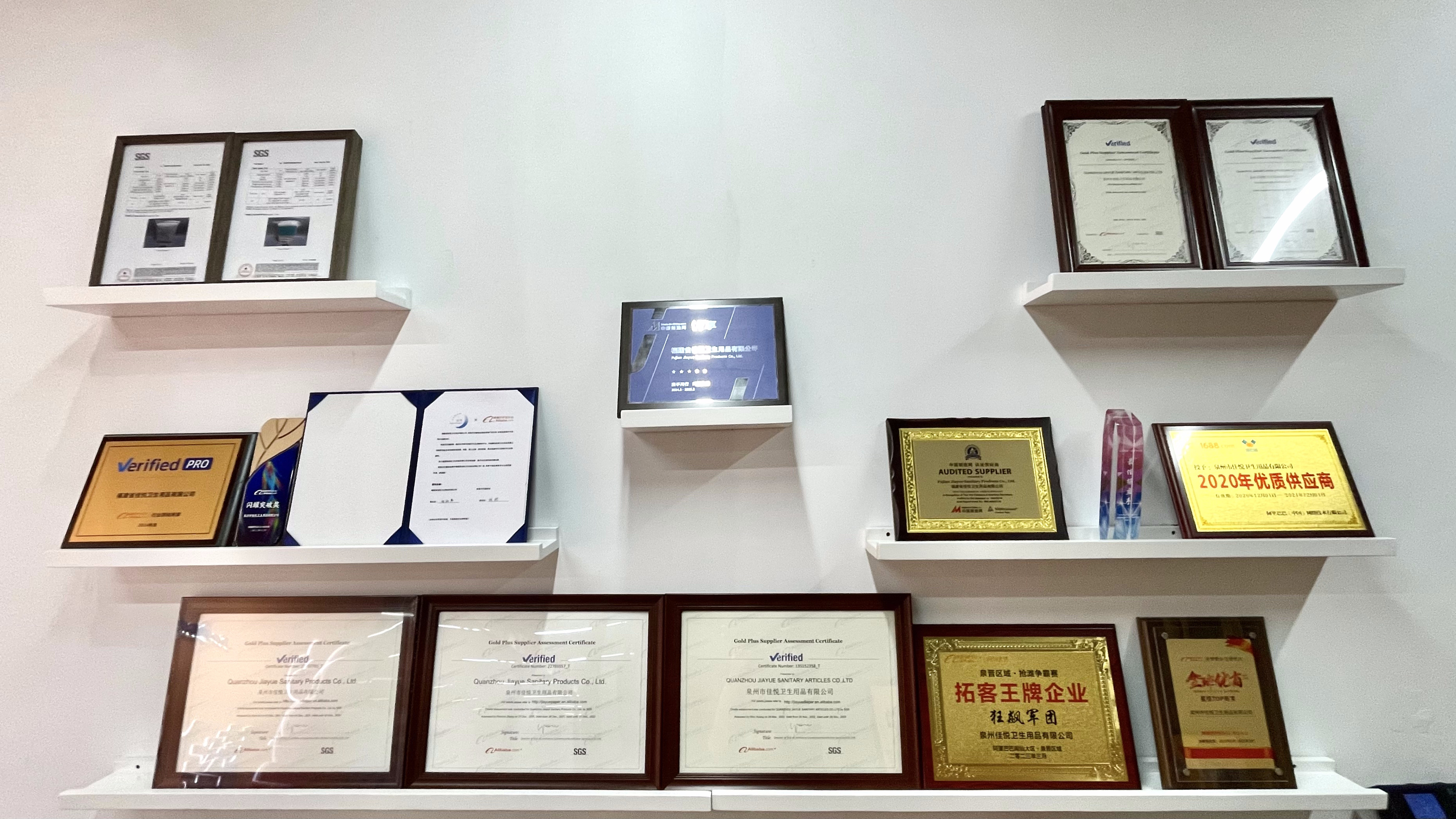
Compliance is the constraint that most often delays a first shipment, because different markets require different documents for the same product. For baby diapers produced by Fujian Jiayue Sanitary Products Co., Ltd. under the Yibero brand, the verified document set includes the following.
| Document | Number | Standard | Validity |
|---|---|---|---|
| CE Declaration of Conformity — Baby Diapers (EU Declaration of Conformity, PPE Category I) | CE/PPE-JY-01 | Regulation (EU) 2016/425 on Personal Protective Equipment; Module A according to Annex IV | Issued 2025-05-15; no recorded expiry date |
| ISO 9001 Quality Management System Certificate | NOA2314690 | GB/T 19001-2016 / ISO 9001:2015 | Issued 2023-12-12; valid until 2026-12-11 |
| ISO 13485 Medical Devices Quality Management System Certificate | NOA2314356 | GB/T 42061-2022 / ISO 13485:2016 | Issued 2023-12-06; valid until 2026-12-05 |
The CE Declaration of Conformity is self-declared by Fujian Jiayue Sanitary Products Co., Ltd., with SUNGO Europe B.V. as the EU representative. Its scope covers baby diapers in sizes NB through XXXXXL, length 36–58 cm and width 28–45.5 cm. The ISO 9001 certificate is issued by NOA Testing & Certification Group Ltd. and covers the sales of sanitary products, maternal and infant products, and Class I medical devices. The ISO 13485 certificate, issued by the same body, is limited to Class I medical device sales within its documented scope.
Beyond these certificates, selected products may be supported by SGS test reports and other compliance documents, depending on the applicable product, destination market and order requirements. The practical rule for buyers is simple: name the destination market, the product and the claim you need to support, and request the corresponding document before the order is confirmed, not after production.
How to Specify and Validate a High Absorbency Baby Diaper Order
The sequence below reflects how the Yibero OEM and private-label program moves from an enquiry to a shipment. Each step produces a document, and each document reduces a specific risk.
Step 1 — Define the destination market and the required document set
Start with the market, not the product. The document set determines the label language, the performance claims you may legally print and the test reports you need. Confirm whether the CE Declaration of Conformity applies to your case, whether additional test reports are required, and who holds the documents. Export documentation is coordinated by the supplier as part of the order.
Step 2 — Fix the size mix and the pack count
Choose the size range and the expected split between S, M, L and XL based on the target market profile. Decide the pack count and the size mix in the carton at this stage, because both affect material consumption, pallet configuration and landed cost. For baby diaper shipments, a container can typically carry a mix of three to four sizes.
Step 3 — Set the absorbency target and the core structure
State the reference absorbency target per size in millilitres and confirm which core structure will deliver it — SAP and fluff pulp, a composite core or an ultra-thin SAP paper core. Ask the supplier’s technical team to explain the trade-off between absorbency, thickness and unit weight for the configuration you are considering. Fujian Jiayue’s in-house R&D and technical support team includes eight engineers responsible for material selection, absorbent-core design, product development, sampling and specification adjustment.
Step 4 — Define materials, fit features and packaging
Confirm the topsheet and nonwoven type, the backsheet specification, the tape or pull-up format, leak guards, the waistband, the wetness indicator, pack count, bag and outer carton artwork, and the printed information required by the destination market. Customization can cover size and weight, absorbency target, core type, nonwoven type, backsheet, 3D leak guards, wetness indicator, graphics, printed bags and cartons, and the pack count and size mix.
Step 5 — Approve the sample and agree the quality-control plan
Sampling is the point where a specification becomes a physical reference. Free samples are typically prepared within one to three working days, with the buyer covering courier costs. The approved sample and the signed specification then govern production. Quality control for an order includes specification review, pre-production sample approval, in-process checks and pre-shipment inspection, with the test method, sampling level and acceptance criteria agreed in the contract.
Step 6 — Confirm quotation, MOQ, lead time and terms
Final MOQ, lead time, testing requirements and payment terms are confirmed in the quotation, the approved sample and the sales contract. Ready-to-ship products may support lower minimum order quantities, while OEM order MOQ depends on the product, size mix, materials, packaging and customization requirements. Typical production lead time is approximately 30–45 days, subject to sample, artwork, packaging and specification approval. Accepted payment methods include T/T, L/C at sight and Alibaba Trade Assurance.
Use Cases: Three Buyer Profiles
The same absorbency specification serves different business models differently. Three profiles appear most often in the baby diaper OEM pipeline.
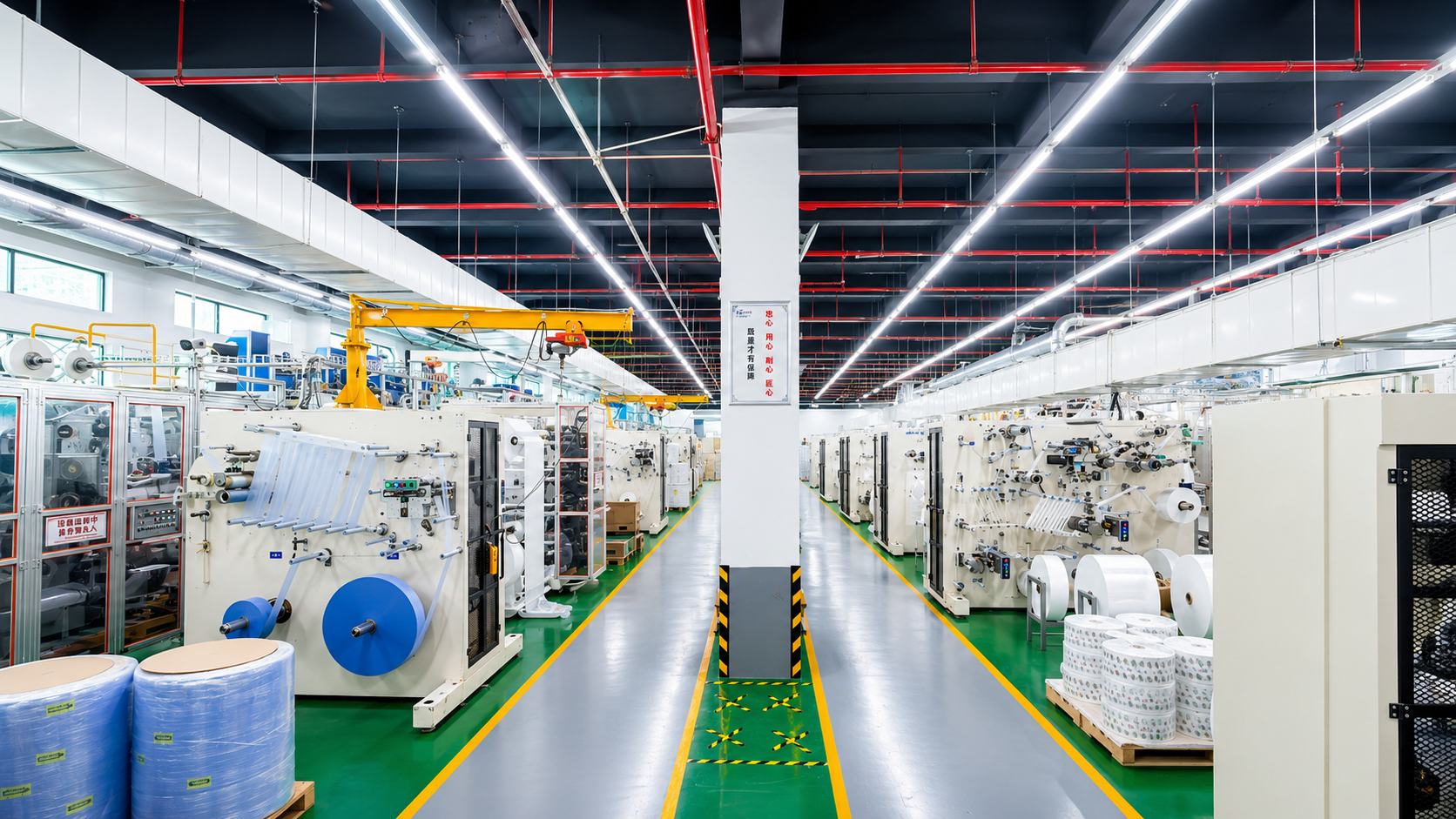
Private-label importer building a premium tier. An importer launching a local brand needs a defensible performance story at the shelf. That usually means targeting the higher end of the absorbency range for each size, combined with a cloth-like breathable backsheet and a wetness indicator, so the premium claim is supported by features the consumer can perceive. Anonymised company references describe private-label baby diaper importers and distributors that started with a trial container and progressed to repeat orders, building local private-label product lines with support on specification, absorbency adjustment, packaging and artwork coordination, size-mix planning, sampling and export documentation.
Distributor or wholesaler serving retail channels. The priority here is repeatability. A distributor selling into supermarkets and pharmacies needs the same specification to arrive on every order, which makes the approved sample and the order-specific quality-control plan more important than the maximum absorbency figure. More than five long-term OEM customers are described as having developed from initial orders into established local brands with repeat orders across multiple overseas markets.
Cross-category buyer consolidating hygiene supply. Buyers who also purchase adult diapers, underpads, wipes, sanitary napkins or pet diapers can consolidate suppliers and shipments. The wider portfolio does not change the baby diaper specification process, but it does change container planning and documentation coordination.

Comparison: Tape-Style Diapers vs Pull-Up Pants
Format is a separate constraint from absorbency, and the two formats are designed for different stages of the same child’s development. Choosing the wrong format for a target demographic creates returns and complaints that no absorbency improvement can fix.
| Decision factor | Tape-style baby diapers | Baby pull-up pants |
|---|---|---|
| Design logic | Tape tabs allow caregivers to open, position and refasten the diaper while the baby is lying down | Elastic waist openings let the product slide on like underwear and stay secure during movement |
| Typical changing scenario | Caregiver-assisted changes, especially for younger babies who spend more time lying down | Convenient dressing and changing for crawling or walking babies and toddlers |
| How absorbency is evaluated | Reference absorbency per size against the approved specification and sample | Same criteria: absorbency, leakage protection, fit and size should still be evaluated for the intended age and use scenario |
| Fit features to confirm | Reusable magic tape, nonwoven frontal tape, elastic waistband, 3D leak guards, wetness indicator | Elastic waist opening, size range and fit, leak guards |
| Buyer decision rule | Choose when the target demographic is younger babies and caregiver-assisted changing dominates | Choose when the target demographic is active and convenience of dressing is a purchase driver |
Both formats sit inside the same OEM and private-label program, so a buyer can order a tape-style range and a pull-up range under one brand, one artwork system and one specification process.
FAQ
Which compliance documents should an importer request from a China baby diaper manufacturer?
The document set depends on the product and the destination market. For baby diapers produced by Fujian Jiayue Sanitary Products Co., Ltd. under the Yibero brand, the verified documents include a CE Declaration of Conformity for baby diapers, certificate number CE/PPE-JY-01, issued 2025-05-15 under Regulation (EU) 2016/425 with SUNGO Europe B.V. as the EU representative; an ISO 9001:2015 certificate, number NOA2314690, valid until 2026-12-11; and an ISO 13485:2016 certificate, number NOA2314356, valid until 2026-12-05, issued within a scope limited to Class I medical device sales. Selected products may also be supported by SGS test reports and other compliance documents. Buyers should note that CE and RoHS are different regulatory frameworks — RoHS restricts hazardous substances in electrical and electronic equipment, while baby diapers are not electrical equipment — so the correct approach is to specify the regulation and the market that apply to your product and request the corresponding report in writing before the order is placed.
Can absorbency, core structure, materials and packaging be customized for a private-label order?
Yes. The Yibero OEM and ODM baby diaper program supports customization of product size and weight, absorbency target, SAP and fluff-pulp or composite core, hot-air or spunbond nonwoven, cloth-like backsheet, tape or pull-up format, 3D leak guards, wetness indicator, waistband, graphics, printed bags and cartons, and the pack count and size mix. The absorbent core in the reference configuration uses imported SAP and fluff pulp, and a fluff pulp and SAP core and an ultra-thin SAP paper core are both available for selected diapers. Because absorbency, thickness, weight and fit trade off against each other, the final configuration is confirmed in the signed specification and the approved sample.
What determines the unit cost of a high absorbency baby diaper order?
Unit cost is driven mainly by the absorbency target, the absorbent core structure and SAP content, the material configuration, the size mix, the pack count and packaging specification, the artwork requirements and the order volume. Company-published cost information places raw material cost at 78–85% of the ex-factory price of diapers, which is why specification changes translate directly into price changes. Ready-to-ship products may support lower minimum order quantities, while OEM order MOQ depends on the product, size mix, materials, packaging and customization requirements. Final MOQ, testing requirements and payment terms are confirmed in the quotation rather than estimated in advance.
How are samples and specifications approved before mass production?
Sampling is the control point for the whole order. Free samples are typically prepared within one to three working days, with the buyer covering courier costs, and the approved sample plus the signed specification become the reference for production. Quality control then follows an order-specific plan covering specification review, pre-production sample approval, in-process checks and pre-shipment inspection, with the test method, sampling level and acceptance criteria agreed in the contract. Buyers evaluating a supplier for the first time can request both the sample and the applicable compliance documents in the same exchange.
What is the typical lead time, container loading and payment term for a first OEM order?
Typical production lead time is approximately 30–45 days, subject to sample, artwork, packaging and specification approval. Baby diaper containers may be loaded with a mix of three to four sizes, which allows a first order to test several size positions in the market at once. The self-owned factory, Quanzhou Jiarun Paper Industry Co., Ltd., supports monthly production and shipment of more than 100 × 40HQ containers, and final available capacity is confirmed against product specifications, packaging and the production schedule. Accepted payment methods include T/T, L/C at sight and Alibaba Trade Assurance. Buyers who want to move from evaluation to a first shipment can request a quotation and a sample set through the contact details below.
Conclusion
High absorbency baby diapers are a specification outcome, not a slogan. The specification starts with reference absorbency per size — 500 ml at size S through 800 ml at size XL in the reference Yibero configuration — and continues through the absorbent core structure, the topsheet and backsheet materials, the leak guards and waistband, the pack count, and the compliance documents that must accompany the shipment into the destination market.
Evaluate a supplier against three verifiable things: a published specification with figures rather than adjectives, management-system and conformity documents with numbers and validity dates, and a sampling and quality-control process that puts the approved sample, not the brochure, at the centre of the order. Buyers who work in that order rarely discover a specification surprise after the container has sailed.
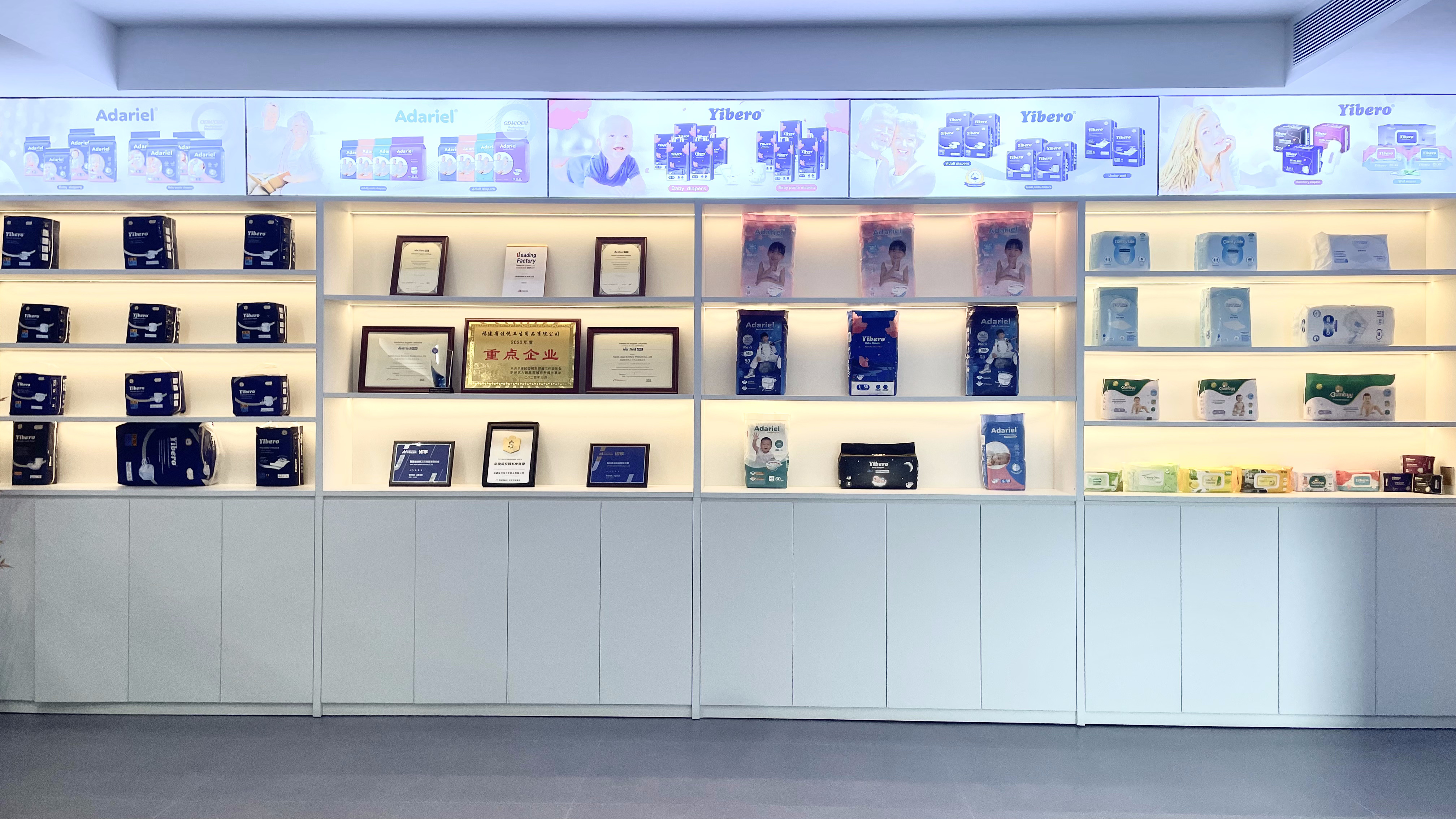
Fujian Jiayue Sanitary Products Co., Ltd. is a hygiene and personal-care product supplier based in Quanzhou, Fujian, China, established in 2016, producing baby diapers, baby pull-up pants, adult diapers, adult pull-up pants, sanitary napkins, underpads, wet wipes, dry wipes, tissue paper, pet diapers and related hygiene products, with OEM, ODM and private-label services for importers, distributors, brand owners and retail channels.

Next step: review the specification on a sample, not on a page.
Request a baby diaper sample set at your target sizes, or ask for a quotation based on your size mix, absorbency target and packaging requirements.
Product catalogue (download): JIAYUE Product Catalog 2026
Email: info@jiayuediaper.com or Lena@jiayuediaper.com | Tel / WhatsApp: +86 159 8030 8853 | Website: jiayuediaper.com
Contact: Lena Lin | Address: 3-901-903, Shengrong Square, No. 1110, Dongpu Rd., Tongyuan Community, Chengdong St., Quanzhou, Fujian, China
Have Questions or Need More Details?
Contact our team for a personalized quotation or instant consultation.
Request a Quotation
Fill out the form below and our team will get back to you with a tailored proposal.
WhatsApp Direct Chat
Prefer to chat in real-time? Message us on WhatsApp for instant assistance & quick answers.
- Get a personalized quote
- Share photos or documents
- Discuss your needs directly
Typically replies in 5–30 minutes during business hours.