Baby Diaper Night Leakage: Set Absorbency Specs Before Order

Night leakage in baby diapers is usually a specification problem that arrives as an after-sales problem. By the time an importer starts receiving leakage complaints, the diaper has already been produced to whatever absorbency target, core structure and fit features were written into the approved order — or to whatever nobody defined. Correcting the specification before the purchase order costs a conversation. Correcting it after the container lands costs returns, marketplace ratings and distributor confidence.
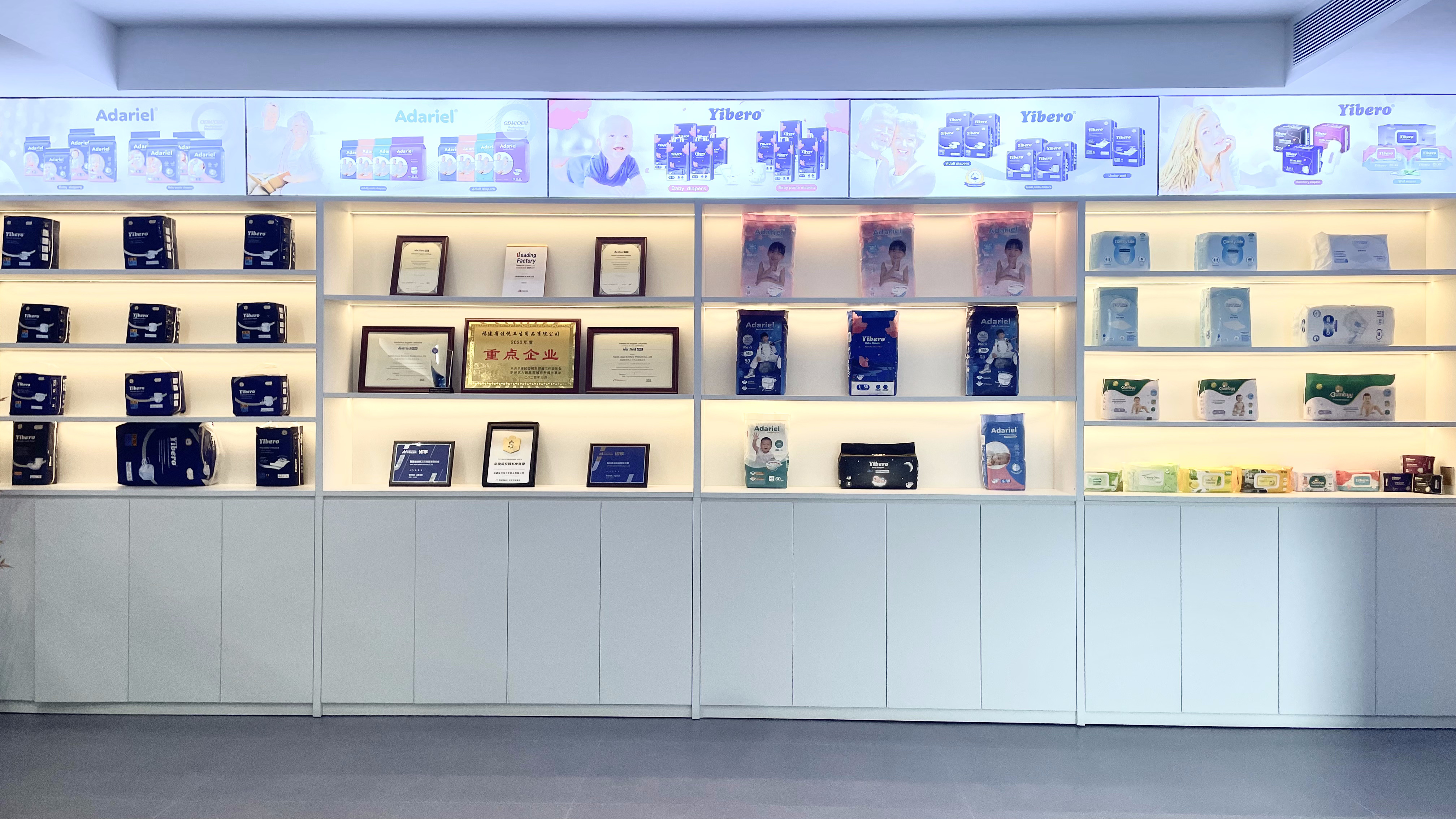
Fujian Jiayue Sanitary Products Co., Ltd. (JIAYUE) is a hygiene and personal-care products manufacturer based in Quanzhou, Fujian, China, established in 2016, supplying baby diapers, baby pull-up pants, adult diapers and related disposable hygiene products through OEM, ODM and private-label arrangements; its baby diaper range is marketed under the Yibero brand. Its order-specific quality-control plan runs from specification review through pre-production sample approval, in-process checks and pre-shipment inspection — a sequence that only works when the absorbency specification being reviewed is precise enough to test against.
Why Night Leakage Becomes an After-Sales Problem, Not a Line Problem
In sourcing terms, night leakage is the failure of a diaper to contain urine across an extended overnight wear period. It is not one defect. Complaints that reach an importer's customer service usually fall into three patterns, and each one maps to a different part of the specification:
- Capacity shortfall. The absorbent core is sized for a shorter wear interval than the market actually uses the product for.
- Fit-related leakage. Urine escapes at the leg cuff or the waist before the core is saturated, because the size band or the elastic configuration does not match the baby's weight and activity level.
- Structure mismatch. The core architecture and peripheral features do not match the positioning printed on the pack — an overnight SKU built on a daytime specification, for example.
None of these can be caught by opening a carton at pre-shipment inspection. Absorbency and fit are performance attributes: they only show up in use, in the destination market, with the buyer's own customers. That delay is what makes leakage expensive, and it is why the production record can show a fully compliant batch while the importer absorbs the complaint.
The controllable part. An importer cannot control how a caregiver uses the product. An importer can control four things: the reference absorbency per size, the absorbent-core structure, the leakage-control features, and the conditions under which the absorbency claim is verified. Those four items separate a specification from a promise.
A Crowded Supply Base Does Not Reduce Specification Risk
Baby diapers are a large, well-supplied category. Grand View Research values the global baby diaper market at USD 83.3 billion in 2025, and Fortune Business Insights places Asia Pacific at 61.92% of the global market in the same year. On the supply side, Xiamen Customs data cited in JIAYUE's published material puts Fujian province's baby diaper export value at CNY 8.74 billion in 2024 — a figure that reflects the density of the Quanzhou manufacturing cluster JIAYUE operates in.
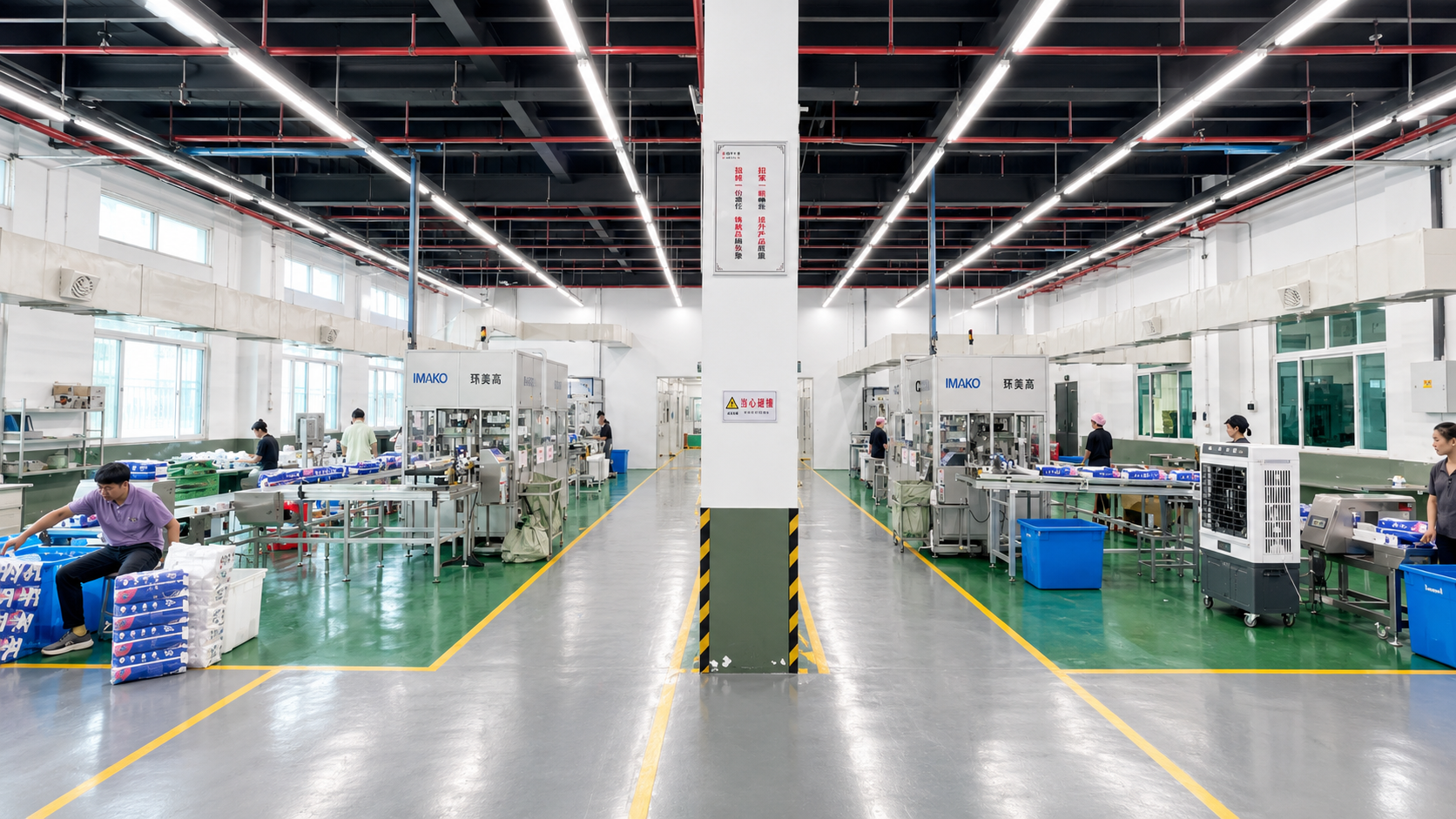
Density has a side effect that matters to buyers in the evaluation stage: quotations for visually similar diapers converge, and the real differences move into documents rather than photographs. JIAYUE's own figures describe a supplier built for volume — production through its self-owned factory, Quanzhou Jiarun Paper Industry Co., Ltd., in a facility covering approximately 20,000 square meters; company-provided production information listing baby diaper line speed at up to 700 pieces per minute; monthly shipment of more than 100 × 40HQ containers; and exports to 70+ countries with a 90% export ratio.
Line-speed figures are supplier-reported and should be read that way. A brochure number is the opening question of a factory audit, not a purchasing fact. The same discipline applies to absorbency: a millilitre figure without a stated test condition cannot be compared across suppliers, because two suppliers can both report '700 ml' and mean two different things.
What the Absorbency Specification Should Actually Say
1. A reference absorbency for every size, tied to a baby-weight band
A usable specification is size-specific. For the Yibero Premium Quality Ultra Cloudy Baby Diapers configuration, JIAYUE publishes the following reference values:
| Size | Dimensions (mm) | Baby weight range | Reference absorbency | Unit weight |
|---|---|---|---|---|
| S | 400 × 320 | 4–8 kg | 500 ml | 26 g |
| M | 450 × 320 | 6–11 kg | 600 ml | 29 g |
| L | 500 × 340 | 9–14 kg | 700 ml | 33 g |
| XL | 540 × 340 | 12–17 kg | 800 ml | 35 g |
Source: JIAYUE product specification for the Yibero Premium Quality Ultra Cloudy Baby Diapers configuration. Shelf life is 5 years under recommended storage conditions.
Two details matter. First, reference absorbency rises with the weight band — 500 ml at size S through 800 ml at size XL. It is a per-size value, not a single number for the whole range, so a supplier who quotes one absorbency figure for 'the diaper' has not yet specified anything. Second, the weight bands overlap: 4–8 kg and 6–11 kg, for example. Overlap is normal, and it is exactly where size-mix decisions get made. The same baby can sit in two adjacent sizes, so whichever size carries the heaviest overnight use in your market deserves the closest attention.
Treat the published value as a reference point for the specification, not as a consumer claim. What the buyer should confirm in writing is the target absorbency per size, how it will be verified, and what the acceptance criteria are.
2. An absorbent-core architecture, chosen deliberately
JIAYUE offers two core directions for selected diaper products, and they are not interchangeable by default:
- Fluff pulp & SAP core — combines cellulose fluff pulp with superabsorbent polymer.
- Ultra-thin SAP paper core — uses SAP paper as the main absorbent structure.
There is no universal performance advantage between the two. The buyer's job is to decide which structure satisfies the SKU's target absorbency, thickness, product weight and fit requirement, then confirm that decision against the approved specification and sample under the same test conditions. The Yibero Premium Quality Ultra Cloudy Baby Diapers configuration uses an imported SAP and fluff-pulp absorbent core, a soft topsheet, nonwoven frontal tape, reusable magic tape, an elastic waistband and a cloth-like breathable backsheet.
Because the two structures differ in how much material sits inside the product, changing the core mid-programme changes unit weight, pack feel and potentially the fit the customer already approved. Core architecture belongs to the development stage, not to a repeat order.
| Comparison point | Fluff pulp & SAP core | Ultra-thin SAP paper core |
|---|---|---|
| Main absorbent structure | Cellulose fluff pulp combined with superabsorbent polymer | SAP paper as the main absorbent structure |
| Availability at JIAYUE | Offered for selected diaper products | Offered for selected diaper products |
| What buyers should compare | Thickness, target absorbency, product weight, fit, material configuration and test results against the approved specification | Thickness, target absorbency, product weight, fit, material configuration and test results against the approved specification |
| Built-in performance advantage | None assumed without testing under the same conditions | None assumed without testing under the same conditions |
3. The leakage-control features that carry overnight performance
Customization at JIAYUE covers product size and weight, absorbency target, SAP/fluff-pulp or composite core, hot-air or spunbond nonwoven, cloth-like backsheet, tape or pull-up format, 3D leak guards, wetness indicator, waistband, graphics, printed bags and cartons, pack count and size mix. Several of these decide whether a diaper leaks at the leg cuff before the core is full — and they are the ones most often left unspecified, because they are invisible in a product photograph.
Write them into the specification sheet one by one, and confirm the format (tape or pull-up) per size rather than per brand. A feature that is not written down cannot be inspected, and a feature that cannot be inspected cannot be defended when a complaint arrives.
4. A same-conditions clause
Absorbency claims should be assessed against the approved specification and test results under the same conditions. This single clause prevents most arguments. Two suppliers can both report 700 ml and mean different things if the sample, test method, load application or acceptance threshold differ. In practice the clause should name five items: sample identity (size, core, batch), test method, test conditions, sampling level and acceptance criteria.
JIAYUE's quality-control model is an order-specific QC plan in which test method, sampling level and acceptance criteria are agreed in the contract. That is the right location for them. A method agreed after the complaint arrives is a negotiation, not a specification.
Six Steps to Lock the Specification Before You Order
- Map the complaint pattern, not just the complaint count. Separate leakage reports by size, by SKU and by wear occasion. A cluster inside XL overnight use points somewhere different from scattered reports across every size.
- Set the target absorbency per size against the weight band. Use the published reference values (500 / 600 / 700 / 800 ml across S / M / L / XL) as the baseline, decide whether an overnight-positioned SKU needs headroom above that baseline, and record the decision in the specification document.
- Choose the core architecture and freeze it. Select fluff pulp & SAP or ultra-thin SAP paper against the target absorbency, thickness and unit weight, then treat the choice as fixed for the approved specification.
- Specify the leakage-control features individually. 3D leak guards, backsheet type, waistband, wetness indicator, nonwoven type and tape-versus-pull-up format, size by size.
- Approve a sample against the written specification. Sample approval only means something when there is a document to approve against. Free samples are typically prepared in 1–3 working days with the buyer covering courier costs, and the sample should be evaluated against the same reference values and test conditions that will apply to mass production.
- Write the QC gates into the contract. Specification review, pre-production sample approval, in-process checks and pre-shipment inspection, with test method, sampling level and acceptance criteria agreed in writing.
Where This Plays Out in Real Orders
Trial container to repeat orders. An anonymized private-label baby diaper importer and distributor developed a local private-label line for wholesale and retail channels, starting from a trial container and progressing to stable repeat-order cooperation. The programme covered specification and absorbency adjustment, packaging and artwork coordination, size-mix planning, sampling and export documentation — and because the absorbency question was settled at development stage, repeat orders did not reopen it. The listed baby diaper configuration carries a 5-year shelf life under recommended storage conditions.
Multi-market OEM programmes. More than five long-term OEM customers across Southeast Asia, South Asia and the Middle East run private-label diaper programmes with JIAYUE, supported by flexible customization and free design support. In multi-market programmes the absorbency specification has to survive several retail price points, pack formats and distribution channels, which is a further argument for keeping it per-size and per-SKU rather than per-brand.
Older babies in pull-up format. Once a baby reaches the 12–17 kg band, the format often shifts from tape-style to pull-up. Leakage complaints in that band more often concern waist and leg fit than core capacity, which puts the elastic waistband and 3D leak guards at the centre of the specification discussion. Both are listed customization options and both should be confirmed on the approved sample rather than assumed from the format name.

Matching the Complaint to the Specification Lever
The table below is a specification checklist, not a diagnosis. It connects the complaint patterns importers most often receive to the specification items that can be locked before an order is placed.
| Complaint pattern | What it usually indicates | Specification lever to lock before ordering |
|---|---|---|
| Overnight leakage across the whole size | Core capacity below the actual wear interval | Target absorbency per size, core architecture (fluff pulp & SAP or ultra-thin SAP paper), unit weight per size |
| Leakage at the leg cuff with a partially wet diaper | Containment and fit rather than saturation | 3D leak guards, size versus baby-weight band, backsheet and nonwoven configuration |
| Leakage at the waist or back in active babies | Format and waistband fit | Tape or pull-up format per size, elastic waistband, size-mix decision |
| Product feels bulky for overnight wear | Structure and material weight | Core architecture, unit weight, cloth-like breathable backsheet |
| Caregivers cannot tell when a change is due | No visible change signal | Wetness indicator |
| Complaints about stuffiness | Breathability of the outer layer | Cloth-like breathable backsheet, hot-air or spunbond nonwoven selection |
Used this way, absorbency stops being a marketing number and becomes an acceptance criterion. The buyer does not need to argue about which product 'absorbs more'; the buyer needs a written target, an approved sample and a test result produced under the same conditions.

Frequently Asked Questions
Which documents should an importer verify before ordering baby diapers?
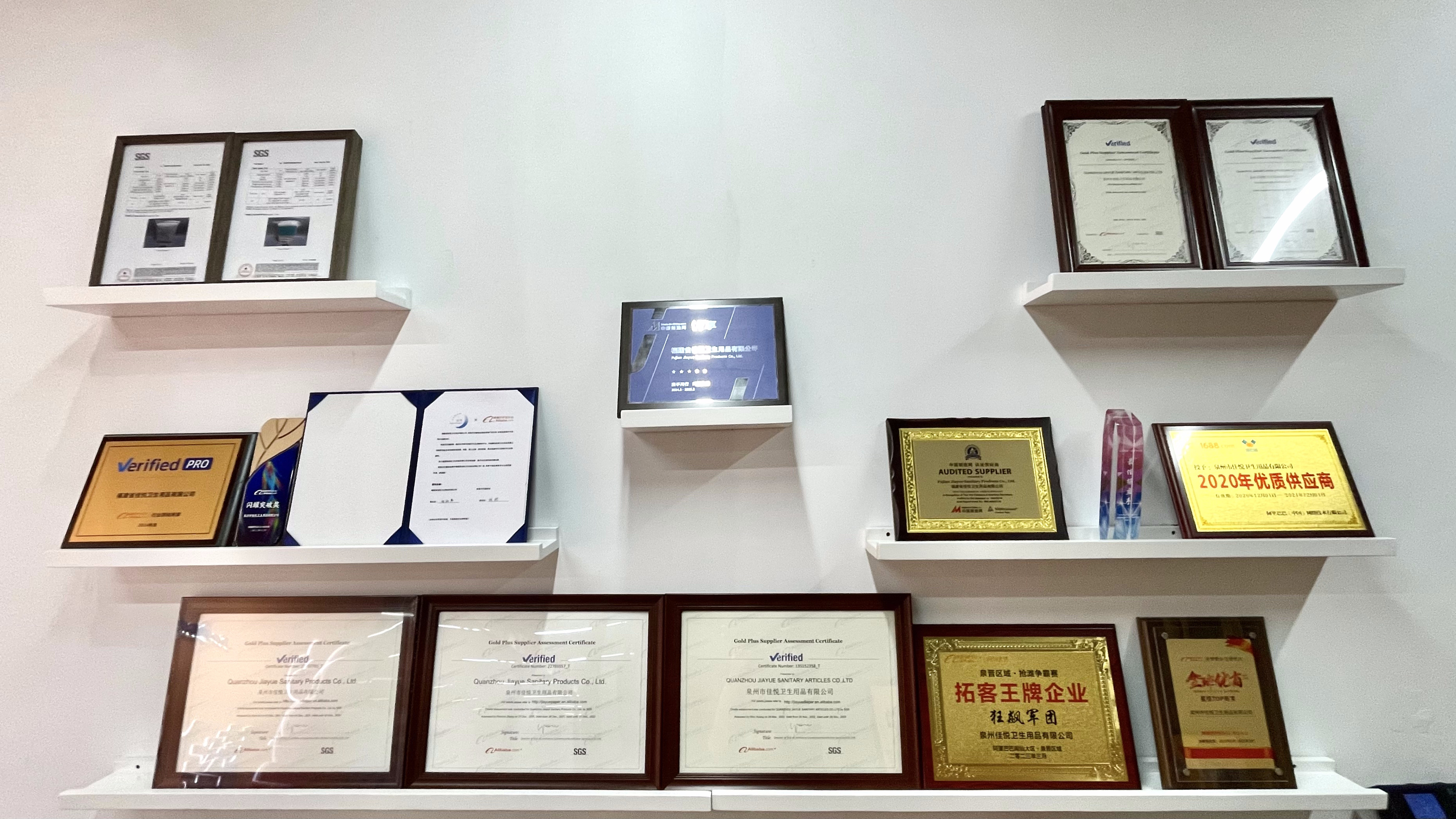
JIAYUE holds ISO 9001 certificate NOA2314690 (GB/T 19001-2016 / ISO 9001:2015), issued 2023-12-12 and valid to 2026-12-11, with a scope covering the sales of sanitary products, maternal and infant products and Class I medical devices; and ISO 13485 certificate NOA2314356 (GB/T 42061-2022 / ISO 13485:2016), issued 2023-12-06 and valid to 2026-12-05, with a scope covering Class I medical device sales. Both were issued by NOA Testing & Certification Group Ltd., and both scopes are limited to the certified sales activities. For the European Union, the baby diaper range is covered by CE Declaration of Conformity CE/PPE-JY-01, a self-declaration under Regulation (EU) 2016/425 (PPE Category I, Module A per Annex IV), issued 2025-05-15 with SUNGO Europe B.V. as EU representative, covering sizes NB to XXXXXL, length 36–58 cm and width 28–45.5 cm. Selected products may additionally be supported by SGS test reports and other compliance documents depending on product, destination market and order requirements — confirm the applicable set in the quotation.
How do I shortlist reliable Chinese baby diaper manufacturers for an importer shortlist?
Shortlist on verifiable structure rather than catalogue photography. For JIAYUE the verifiable points are: the legal entity Fujian Jiayue Sanitary Products Co., Ltd., established 2016; production through the self-owned factory Quanzhou Jiarun Paper Industry Co., Ltd., in a facility of approximately 20,000 square meters; an in-house R&D and technical support team of 8 engineers covering material selection, absorbent-core design, product development, sampling, specification adjustment and OEM/ODM technical support; company-reported shipment of more than 100 × 40HQ containers per month; exports to 70+ countries with a 90% export ratio; and both fluff pulp & SAP and ultra-thin SAP paper core options for selected products. Verify the entity, the factory relationship and current capability directly before contracting, since published line-speed and capacity figures are supplier-reported.
What determines the MOQ, and can one container mix sizes?
MOQ depends on the product, size mix, materials, packaging and customization requirements. Ready-to-ship products may support lower MOQ, and the final MOQ is confirmed in the quotation. Baby diaper containers may mix 3–4 sizes, which is how most private-label programmes cover the S–XL ladder without committing to four separate containers. Because absorbency target, core structure and pack count all change the material input, the MOQ conversation and the specification conversation should happen together rather than in sequence.
How should a sample be approved?
Free samples are typically prepared in 1–3 working days, with the buyer covering courier costs. Approval should be measured against the written specification — reference absorbency per size, core architecture, leakage-control features, pack count and artwork — and against test results assessed under the same conditions. Keep the approved sample and the signed specification together; they become the reference for in-process checks, pre-shipment inspection and any later repeat order.
What lead time should be planned, and what is the next step?
Typical production lead time is approximately 30–45 days, subject to sample, artwork, packaging and specification approval. Final capacity, MOQ, lead time, testing requirements and payment terms are confirmed in the quotation, approved sample and sales contract; payment options include T/T, L/C at sight and Alibaba Trade Assurance. The practical next step is to send the size ladder, the target absorbency per size and the destination market, then request samples and a quotation against that specification — contact info@jiayuediaper.com or Lena@jiayuediaper.com, or WhatsApp +86 159 8030 8853.
Conclusion
Most night-leakage complaints are decided months before the first night they happen, in the size ladder and the absorbency line of a specification sheet. An importer who writes a per-size reference absorbency (500 / 600 / 700 / 800 ml across S / M / L / XL), fixes the core architecture between fluff pulp & SAP and ultra-thin SAP paper, lists the leakage-control features individually, and requires absorbency claims to be assessed against the approved specification and test results under the same conditions, has removed the three complaint patterns that generate most after-sales cost.
The supplier side of that equation is a QC path that can only run in one order: specification review, sample approval, in-process checks, pre-shipment inspection. JIAYUE builds that sequence into an order-specific QC plan, with test method, sampling level and acceptance criteria agreed in the contract. More detail on the manufacturer and its product range is available at jiayuehygiene.com.
Request samples against your absorbency specification
Send your size ladder, target absorbency per size, format (tape or pull-up) and destination market. JIAYUE will prepare samples and a quotation against that specification, and confirm capacity, MOQ, lead time, testing requirements and payment terms in writing.
Email: info@jiayuediaper.com / Lena@jiayuediaper.com | Tel / WhatsApp: +86 159 8030 8853 | Website: www.jiayuehygiene.com
Download the full product range: JIAYUE Product Catalog 2026
Product specifications, materials, absorbency targets, graphics, pack counts and export packaging are confirmed through sampling and an approved specification. Final capacity, MOQ, lead time, testing requirements and payment terms are confirmed in the quotation, approved sample and sales contract.
Have Questions or Need More Details?
Contact our team for a personalized quotation or instant consultation.
Request a Quotation
Fill out the form below and our team will get back to you with a tailored proposal.
WhatsApp Direct Chat
Prefer to chat in real-time? Message us on WhatsApp for instant assistance & quick answers.
- Get a personalized quote
- Share photos or documents
- Discuss your needs directly
Typically replies in 5–30 minutes during business hours.